Why Plant Beni Schichihenge Japanese Maple?
A small tree for big-time drama! Beni Schichihenge Japanese Maple is a compact, slow-growing ornamental tree that will make a big impact in your garden. In spring, it hogs the spotlight with new, mint-green foliage that is liberally and irregularly rimmed in coral-red. In summer, the margins change to a paler peachy-pink with hints of cream. With the cooler temperatures of fall, yet another transformation takes place—this time the leaves turn vibrant gold and orange. Plant Beni Schichihenge by the patio, outside your kitchen window, or wherever you’ll be able to see it every day and track its fascinating changes!A small tree for big-time drama! Beni Schichihenge Japanese Maple is a compact, slow-growing ornamental tree that will make a big impact in your garden. In spring, it hogs the spotlight with new, mint-green foliage that is liberally and irregularly rimmed in coral-red. In summer, the margins change to a paler peachy-pink with hints of cream. With the cooler temperatures of fall, yet another transformation takes place—this time the leaves turn vibrant gold and orange. Plant Beni Schichihenge by the patio, outside your kitchen window, or wherever you’ll be able to see it every day and track its fascinating changes! Japanese Maples, native to Japan, China, and Korea, have many passionate fans all around the world. As with a lot of plants with a long history in gardens, innumerable selections have arisen over the years and have been preserved through propagation. Beni Schichihenge was discovered in Japan and was introduced to the West in 1967. Its name means “Red and Changing”—an appropriate moniker for this dynamic plant. Although it’s been around for a while, Beni Schichihenge is rare in the trade. Its slow growth makes production at the nursery time-consuming. We are proud to be able to offer it!Japanese Maples, native to Japan, China, and Korea, have many passionate fans all around the world. As with a lot of plants with a long history in gardens, innumerable selections have arisen over the years and have been preserved through propagation. Beni Schichihenge was discovered in Japan and was introduced to the West in 1967. Its name means “Red and Changing”—an appropriate moniker for this dynamic plant. Although it’s been around for a while, Beni Schichihenge is rare in the trade. Its slow growth makes production at the nursery time-consuming. We are proud to be able to offer it!
How to use Beni Schichihenge Japanese Maple in the landscape?
Beni Schichihenge’s leaf stalks and its youngest branches are a rich red color, adding another dimension to this dazzling plant. As if it weren’t colorful enough already! Beni Schichihenge’s leaf stalks and its youngest branches are a rich red color, adding another dimension to this dazzling plant. As if it weren’t colorful enough already!
How To Plant Beni Schichihenge Japanese Maple
Beni Schichihenge Japanese Maple is happiest in moderate climates where winters are neither too frigid, nor summers too hot and steamy. In the warmer parts of its range, it appreciates some shade from the afternoon sun, though it can be grown in full sun where summers are mild. Wind protection is advisable in sites exposed to freezing winter winds. Beni Schichihenge isn’t fussy about soil, as long as it isn’t wet. Like most Maple Trees, it does occasionally fall prey to verticillium wilt, a fungal disease present in some soils. The disease is more likely to attack stressed trees, and proper cultural care is the best means of defense against it. Beni Schichihenge Japanese Maple is happiest in moderate climates where winters are neither too frigid, nor summers too hot and steamy. In the warmer parts of its range, it appreciates some shade from the afternoon sun, though it can be grown in full sun where summers are mild. Wind protection is advisable in sites exposed to freezing winter winds. Beni Schichihenge isn’t fussy about soil, as long as it isn’t wet. Like most Maple Trees, it does occasionally fall prey to verticillium wilt, a fungal disease present in some soils. The disease is more likely to attack stressed trees, and proper cultural care is the best means of defense against it.
How Does Shipping Work?
Bower & Branch Trees, the real BIG trees, don’t fit in a box! Our big trees, sizes XL and bigger, require expert delivery and care, that means our extra-large trees are shipped on Bower & Branch trucks. We are the only ones who know how to ship our big and bigger trees and plants with tender loving care. We deliver your trees and plants directly to you. Ask Bower & Branch about planting services – we'd be happy to assist in installation.
*For Big trees and Shrubs, Size XL and bigger: Review our Seasonal Shipping Timelines and Policy here.
Your trees and plants are grown across the United States at various Bower & Branch Growers. Depending on your location, your plant orders may be shipped from various locations. Please expect orders with multiple items to be delivered over a number of days as a result. Orders made up of numerous items or selections will not arrive at your home on the same day.
Shipping Delays:
From time to time, Bower & Branch Growers may determine to delay order shipment based on various factors for plant health. Weather in your region, as well as, where your plants are grown, is always considered when shipping. Extreme weather conditions may delay some or all of your order. Bower & Branch allows our Growers to make final shipping decisions based solely to benefit your trees and plants’ health and success.
How Does Sizing Work?
The size of our trees have nothing to do with the container size like you may find elsewhere–big doesn't mean just height - it’s also vigor, age, and overall health. Other online retailers are going to tell you that a plant is a seven gallon, that means nothing to your tree or plant (or you.)
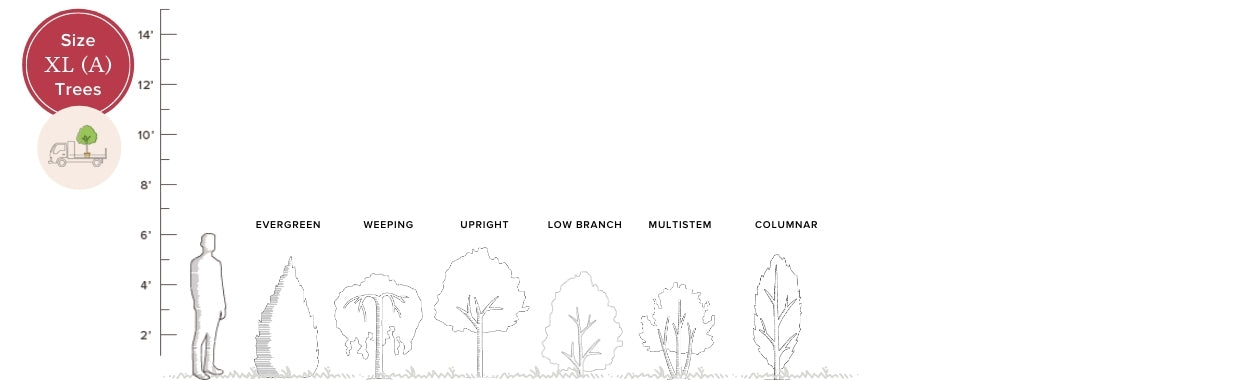
Our trees for sale online are graded on large, x-large, and even bigger sizes. This is because our trees are sized by their age—the higher the letter, the more mature the tree. The age determines the trees’ overall height, size of the trunk and the overall branch density.
All of these characteristics are what you should be looking for when choosing a tree for immediate impact and instant curb appeal. Our extra-large tree and plant sizes are sure to wow you and your neighbors!
See the size guides below.