Why Plant Chionoides Rhododendron?
When most of the great flowering trees of spring are finishing up and summer Spirits have yet to show their colors, one stellar Accent bursts onto the scene. Catawba Rhododendron takes the stage, displaying big, beautiful bunches of lavender, pink, and white blooms for all to see. The voluptuous flowers are the perfect embodiment of that sweet season. Chionoides Catawba Rhododendron is a picture of grace and abundance at that time with its elegant clusters of crisp white blossoms. Use it in your foundation beds, where it will brighten your landscape when in bloom and provide welcome, lush greenery the rest of the year. Chionoides is a type of Catawba Rhododendron. From April through June, the Catawba Rhododendron lights up shady hillsides and forest understory in the Alleghany Mountains, bringing its rosy purple cheer to a region extending from southern Virginia to northern Alabama. Chionoides therefore has its roots in the U.S., but it also owes an allegiance to England, where it first appeared. A nurseryman named John Standish introduced it in 1867. Its name (pronounced ky-on-oh-EYE-deez) means “looks like snow” in Greek, and it’s not hard to imagine the rounded flower clusters as frosty-white snowballs.
How to use Chionoides Rhododendron in the landscape?
Some Rhododendrons can be a bit tricky to grow, but Chionoides is one of the most resilient. With proper care, it thrives in the colder states—down to -20ºF. It tolerates more sun than other Rhododendrons as well. This one is a winner!
How To Plant Chionoides Rhododendron
Catawba Rhododendron is tougher than many Rhododendrons, but it does appreciate good siting and aftercare. Plant Chionoides in part shade, in cool, acidic, well-drained soil for best results. Keep the rootzone moist but never soggy. An annual layer of organic mulch will help to retain moisture. Avoid harsh chemical fertilizers—Catawba Rhododendron is sensitive to overfeeding;a gentle organic product like Bower & Branch Elements™ Fertilizer is all that is needed if plants seem weak or “hungry.” Black vine weevil and Azalea lace bug can sometimes be an issue, but specimens grown in optimal conditions in most cases will remain healthy and resistant to attack.
How Does Shipping Work?
Bower & Branch Trees, the real BIG trees, don’t fit in a box! Our big trees, sizes XL and bigger, require expert delivery and care, that means our extra-large trees are shipped on Bower & Branch trucks. We are the only ones who know how to ship our big and bigger trees and plants with tender loving care. We deliver your trees and plants directly to you. Ask Bower & Branch about planting services – we'd be happy to assist in installation.
*For Big trees and Shrubs, Size XL and bigger: Review our Seasonal Shipping Timelines and Policy here.
Your trees and plants are grown across the United States at various Bower & Branch Growers. Depending on your location, your plant orders may be shipped from various locations. Please expect orders with multiple items to be delivered over a number of days as a result. Orders made up of numerous items or selections will not arrive at your home on the same day.
Shipping Delays:
From time to time, Bower & Branch Growers may determine to delay order shipment based on various factors for plant health. Weather in your region, as well as, where your plants are grown, is always considered when shipping. Extreme weather conditions may delay some or all of your order. Bower & Branch allows our Growers to make final shipping decisions based solely to benefit your trees and plants’ health and success.
How Does Sizing Work?
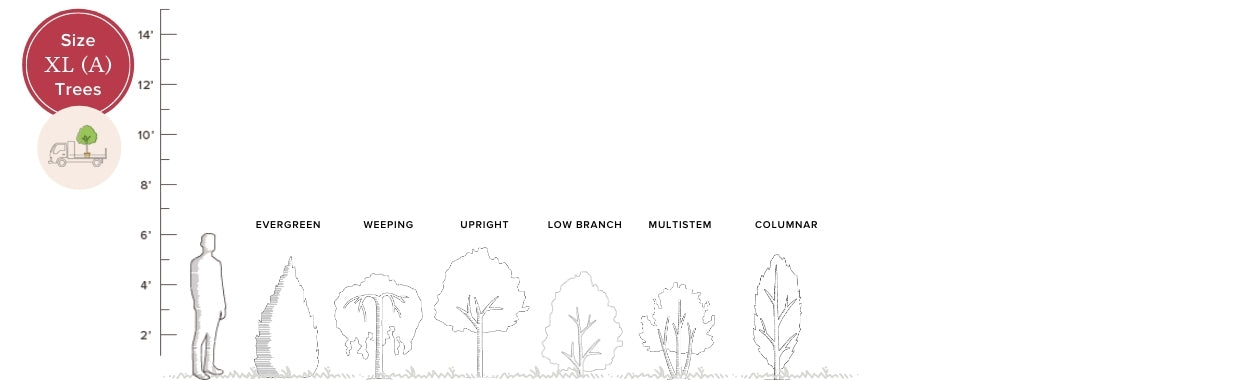
The size of our trees have nothing to do with the container size like you may find elsewhere–big doesn't mean just height - it’s also vigor, age, and overall health. Other online retailers are going to tell you that a plant is a seven gallon, that means nothing to your tree or plant (or you.)
Our trees for sale online are graded on large, x-large, and even bigger sizes. This is because our trees are sized by their age—the higher the letter, the more mature the tree. The age determines the trees’ overall height, size of the trunk and the overall branch density.
All of these characteristics are what you should be looking for when choosing a tree for immediate impact and instant curb appeal. Our extra-large tree and plant sizes are sure to wow you and your neighbors!
See the size guides below.