Why Plant Blue Jay Highbush Blueberry?
Grow a luscious landscape! Bluejay Highbush Blueberry is a treat for both the taste buds and the eyes. Every summer you’ll look forward to lots of yummy fruits for fresh eating, cobbler, pies, and smoothies—right outside your door. But don’t think that you have to hide this handy Accent in the backyard. Blueberry plants are pretty enough to put on display! They’re especially enchanting in autumn, when the dark green foliage becomes a blazing bonfire of scarlet, orange, and gold. Bluejay is a classic selection that delivers delectable, medium to large berries and fiery fall color. Ravishing!
So many of the plants we grow for food come from distant places. The Highbush Blueberry is a homegrown American native. It grows in the wild from Maine all the way to Florida, ranging westward to Minnesota and Louisiana. Over the years, plant breeders have worked to improve the size, flavor, and quantity of its berries. Bluejay stands out for its fast growth and juicy fruits that are produced in abundance. It’s also noteworthy for the way the berries hang on the plant for an extended period without losing flavor. That means you get to keep picking for a long time!
How to use Blue Jay Highbush Blueberry in the landscape?
Take the time to appreciate Bluejay Highbush Blueberry’s exquisite flowers in the spring. The dainty white blossoms, shaped like tiny, upside-down urns, make a pleasing show. Honey bees love the blooms, and they get right to work pollinating them.
Planting Zones
Hardiness Zone: 4-8

How To Plant Blue Jay Highbush Blueberry
Acid soil is key to growing Blueberries successfully. These peat-loving Accents require very low–pH conditions in order to thrive. If your soil isn’t naturally acidic, you may want to grow Bluejay Blueberry in a large container or raised bed. Give it all-day sun if possible and use lots of organic matter—both as a soil amendment and as mulch. Water weekly if no rain falls. Bluejay Blueberry is self-pollinating, so you don’t need to plant another variety nearby. It’s perfect for owners of small gardens who don’t have the space for multiple plants.
How Does Shipping Work?
Bower & Branch Trees, the real BIG trees, don’t fit in a box! Our big trees, sizes XL and bigger, require expert delivery and care, that means our extra-large trees are shipped on Bower & Branch trucks. We are the only ones who know how to ship our big and bigger trees and plants with tender loving care. We deliver your trees and plants directly to you. Ask Bower & Branch about planting services – we'd be happy to assist in installation.
*For Big trees and Shrubs, Size XL and bigger: Review our Seasonal Shipping Timelines and Policy here.
Your trees and plants are grown across the United States at various Bower & Branch Growers. Depending on your location, your plant orders may be shipped from various locations. Please expect orders with multiple items to be delivered over a number of days as a result. Orders made up of numerous items or selections will not arrive at your home on the same day.
Shipping Delays:
From time to time, Bower & Branch Growers may determine to delay order shipment based on various factors for plant health. Weather in your region, as well as, where your plants are grown, is always considered when shipping. Extreme weather conditions may delay some or all of your order. Bower & Branch allows our Growers to make final shipping decisions based solely to benefit your trees and plants’ health and success.
How Does Sizing Work?
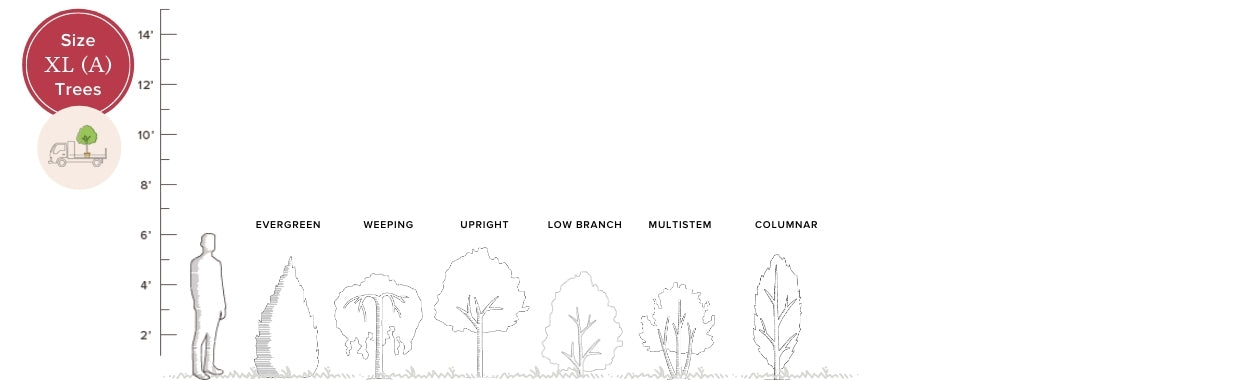
The size of our trees have nothing to do with the container size like you may find elsewhere–big doesn't mean just height - it’s also vigor, age, and overall health. Other online retailers are going to tell you that a plant is a seven gallon, that means nothing to your tree or plant (or you.)
Our trees for sale online are graded on large, x-large, and even bigger sizes. This is because our trees are sized by their age—the higher the letter, the more mature the tree. The age determines the trees’ overall height, size of the trunk and the overall branch density.
All of these characteristics are what you should be looking for when choosing a tree for immediate impact and instant curb appeal. Our extra-large tree and plant sizes are sure to wow you and your neighbors!
See the size guides below.