Why Plant Chojuro Asian Pear?
Have you ever tried an Asian pear from the supermarket? You know—those odd, golden brown, apple-shaped fruits you see in the fall and winter? They’re often packaged in Styrofoam wrappers because they bruise so easily, and they cost a small fortune. Well, we’re sorry to inform you that if you’ve only tried Asian pears from the grocery store, you probably haven’t had a real Asian pear. You see, supermarket Asian pears are picked before they’re perfectly ripe, and unlike European pears, they don’t ripen off the tree, so in eating them you’ll never know this special fruit’s true potential. The Chojuro Asian Pear, for example, has a delightfully sweet flavor at peak ripeness that carries notes of butterscotch. You’ll have to grow your own tree to truly enjoy this extraordinary treat! Although Asian pears may be little known to most Westerners, they have a long history in the East. In China, where they first originated, they have been cherished for over 2,000 years. The early-blooming white Pear blossoms are a welcome sign of spring there, and the fruits are held in the highest esteem—it is estimated that 3,000 selections have been made! In the U.S., Asian Pear Trees arrived via Chinese laborers in the 1850s, but the fruits never became mainstream. The Chojuro Asian Pear is a classic selection from Japan that was introduced around 1895. Its name means “Plentiful” in Japanese. Chojuro is valued for its long storage life—up to five months in cool, dry conditions.
How to use Chojuro Asian Pear in the landscape?
Is it a pear? Is it an apple? The Asian pear is sometimes called an apple pear, because it is round and crisp like an apple, but it is, botanically speaking, a pear. The Chojuro Asian Pear is most often eaten fresh (you may choose to peel it first). Chill it in the fridge for a day or two, and then add slices to a salad to give it a wonderful, crunchy kick.
How To Plant Chojuro Asian Pear
Plant your Chojuro Asian Pear Tree in an open site with good air circulation and all-day sun. Good drainage is a must, as Pear Trees don’t tolerate soggy soil. However, regular irrigation is also important, especially during the first year or two of establishment, so use the Bower & Branch Elements™ Watering System to deliver just the right amount of moisture to the roots. Chojuro will bear some fruit on its own, but will produce much more fruit with another Pear Tree nearby. In fact, this selection may bear too many fruits for its branches to support, so you’ll probably have to thin the pears when they’re the size of a cherry. This tree isn’t immune to pests and diseases, though these can be controlled or prevented with some know-how. Please don’t hesitate to contact our expert growers at grower@bowerandbranch.com for advice on cultivating this or any of the trees we offer.
How Does Shipping Work?
Bower & Branch Trees, the real BIG trees, don’t fit in a box! Our big trees, sizes XL and bigger, require expert delivery and care, that means our extra-large trees are shipped on Bower & Branch trucks. We are the only ones who know how to ship our big and bigger trees and plants with tender loving care. We deliver your trees and plants directly to you. Ask Bower & Branch about planting services – we'd be happy to assist in installation.
*For Big trees and Shrubs, Size XL and bigger: Review our Seasonal Shipping Timelines and Policy here.
Your trees and plants are grown across the United States at various Bower & Branch Growers. Depending on your location, your plant orders may be shipped from various locations. Please expect orders with multiple items to be delivered over a number of days as a result. Orders made up of numerous items or selections will not arrive at your home on the same day.
Shipping Delays:
From time to time, Bower & Branch Growers may determine to delay order shipment based on various factors for plant health. Weather in your region, as well as, where your plants are grown, is always considered when shipping. Extreme weather conditions may delay some or all of your order. Bower & Branch allows our Growers to make final shipping decisions based solely to benefit your trees and plants’ health and success.
How Does Sizing Work?
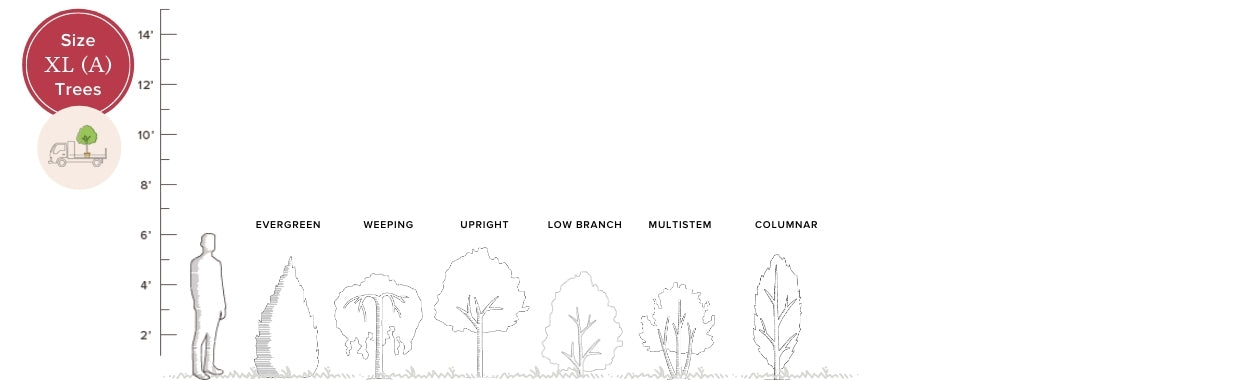
The size of our trees have nothing to do with the container size like you may find elsewhere–big doesn't mean just height - it’s also vigor, age, and overall health. Other online retailers are going to tell you that a plant is a seven gallon, that means nothing to your tree or plant (or you.)
Our trees for sale online are graded on large, x-large, and even bigger sizes. This is because our trees are sized by their age—the higher the letter, the more mature the tree. The age determines the trees’ overall height, size of the trunk and the overall branch density.
All of these characteristics are what you should be looking for when choosing a tree for immediate impact and instant curb appeal. Our extra-large tree and plant sizes are sure to wow you and your neighbors!
See the size guides below.