Why Plant Pallida Witch Hazel?
Spring is so close—can you smell it? The Pallida Tree Form Witch Hazel pours out its spicy-sweet scent during the last days of winter, while the rest of the garden is still asleep. As soon as you catch a whiff of its intoxicating perfume, you’ll know that the finish line’s in sight, and pleasant spring days are just ahead. It’s an event you’ll look forward to every year. Plant your Pallida Witch Hazel near a path or entryway, so your guests can examine the interesting blossoms up close. The thin, curly, light yellow petals look like lemon zest and have the curious habit of curling up when the temperature drops sharply. Such funny little thermometers! You may know Witch Hazel as an ingredient in facial cleansers and aftershave. This extract comes from an American Witch Hazel species that opens its small yellow blooms in the fall. The Pallida variety is a cousin to the American species. It originated in Europe from Asian parents. In a neglected Dutch arboretum, a Japanese Witch Hazel and a Chinese Witch Hazel growing near one another were pollinated by an early-season honeybee, producing hybrid seed. The folks at Wisley Garden in England acquired some of that seed and one of the seedlings they raised was Pallida. They introduced the new plant to the world in 1932. The original plant still brightens winter days at Wisley.
How to use Pallida Witch Hazel in the landscape?
Pallida Witch Hazel will light up your landscape with luminescent yellow flowers in late winter, but it is a bit of a drama queen in fall, too. That’s when its rich green foliage takes on a cheerful golden glow.
How To Plant Pallida Witch Hazel
The Pallida Witch Hazel naturally grows as vase-shaped shrub, but we have grafted it onto the trunk of a related tree called the Parrotia to lift it up off the ground and give it single-stem tree shape. The Parrotia is a tough tree and is adaptable regarding soil types. It is also quite drought tolerant once established, though regular irrigation (with good drainage) will yield the best results. Plant your Pallida Witch Hazel in a site that receives part shade or all-day sun. It will grow in deeper shade, but flowering may be sparse there. Because this is a grafted tree, you’ll want to be on the lookout for Parrotia branches that sprout from below the graft union and prune them out immediately. Look carefully, because the Parrotia and Witch Hazel leaves are similar.
How Does Shipping Work?
Bower & Branch Trees, the real BIG trees, don’t fit in a box! Our big trees, sizes XL and bigger, require expert delivery and care, that means our extra-large trees are shipped on Bower & Branch trucks. We are the only ones who know how to ship our big and bigger trees and plants with tender loving care. We deliver your trees and plants directly to you. Ask Bower & Branch about planting services – we'd be happy to assist in installation.
*For Big trees and Shrubs, Size XL and bigger: Review our Seasonal Shipping Timelines and Policy here.
Your trees and plants are grown across the United States at various Bower & Branch Growers. Depending on your location, your plant orders may be shipped from various locations. Please expect orders with multiple items to be delivered over a number of days as a result. Orders made up of numerous items or selections will not arrive at your home on the same day.
Shipping Delays:
From time to time, Bower & Branch Growers may determine to delay order shipment based on various factors for plant health. Weather in your region, as well as, where your plants are grown, is always considered when shipping. Extreme weather conditions may delay some or all of your order. Bower & Branch allows our Growers to make final shipping decisions based solely to benefit your trees and plants’ health and success.
How Does Sizing Work?
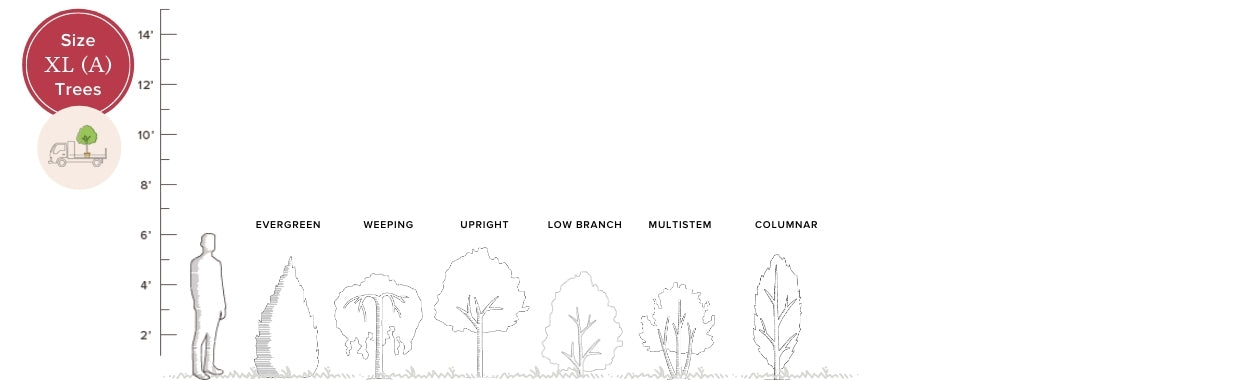
The size of our trees have nothing to do with the container size like you may find elsewhere–big doesn't mean just height - it’s also vigor, age, and overall health. Other online retailers are going to tell you that a plant is a seven gallon, that means nothing to your tree or plant (or you.)
Our trees for sale online are graded on large, x-large, and even bigger sizes. This is because our trees are sized by their age—the higher the letter, the more mature the tree. The age determines the trees’ overall height, size of the trunk and the overall branch density.
All of these characteristics are what you should be looking for when choosing a tree for immediate impact and instant curb appeal. Our extra-large tree and plant sizes are sure to wow you and your neighbors!
See the size guides below.