Why Plant Franklin Tree?
If you’re passionate about trees and fascinated with their histories, then the Franklin Tree, or Franklinia, is a must-have for your collection. Once native to the U.S., this rare and exquisite flowering tree is now extinct in the wild and survives only as a specimen in gardens. And what a specimen it is! In addition to beautiful flowers and a captivating story, the Franklin Tree has something else to offer—amazing fall color! When the days turn crisp and cool, its Magnolia-like leaves heat up, taking on shades of purple, crimson, and scarlet-orange. Sometimes there are even some late white flowers nestled amongst the fiery foliage.
Franklinia was discovered in Georgia in 1765 by John and William Bartram, father and son plant explorers from Pennsylvania. They named the lovely new tree for their good family friend, Benjamin Franklin. William returned to that little grove of trees in 1776 to collect seed, and it’s fortunate he did, because except for one disputed sighting by another botanist in 1803, the Franklin Tree was never seen in the wild again. All of the Franklinias in the world today are descendants of that crop of seedlings William Bartram raised on his Pennsylvania farm during the Revolutionary War.
How to use Franklin Tree in the landscape?
In August and September, when most trees are simply green, Franklinia will grace your mixed border, patio area, or entryway garden with elegant, fragrant white flowers measuring three inches wide or more. They resemble the blossoms of Camellias and Stewartias, to which the Franklin Tree is related. They’re reason enough to throw a garden party!
Planting Zones
Hardiness Zones: 5-8

How To Plant Franklin Tree
Franklinia is a rather persnickety tree and isn’t a good choice for the novice gardener. However, if your thumbs are green, it will be the pride and joy of your garden. Give Franklin Tree a site in full sun or very light shade with moist but well-drained, acidic soil that has lots of organic matter worked in. Despite being a Southern belle, it’s surprisingly cold-hardy and does well in much of New England, provided the soil is to its liking. This is normally a short-lived tree, though a couple of well-tended specimens at the Arnold Arboretum in Boston are over 100 years old.
How To Water
Water regularly after initial planting. Once established, they are more tolerant of drought conditions, reducing your hand-watering responsibilities.
How To Fertilize
During fall, feed your Franklina Bower & Branch Elements Fertilizer once a year for about the first 3 or 4 years - this will give your tree all the nutrients it needs.
How To Prune
Minimal pruning is needed but the best time to do is when the tree is dormant. Franklinia should be pruned to remove any damaged to dying branches, or to maintain the natural, open branching structure.
How Does Shipping Work?
Bower & Branch Trees, the real BIG trees, don’t fit in a box! Our big trees, sizes XL and bigger, require expert delivery and care, that means our extra-large trees are shipped on Bower & Branch trucks. We are the only ones who know how to ship our big and bigger trees and plants with tender loving care. We deliver your trees and plants directly to you. Ask Bower & Branch about planting services – we'd be happy to assist in installation.
*For Big trees and Shrubs, Size XL and bigger: Review our Seasonal Shipping Timelines and Policy here.
Your trees and plants are grown across the United States at various Bower & Branch Growers. Depending on your location, your plant orders may be shipped from various locations. Please expect orders with multiple items to be delivered over a number of days as a result. Orders made up of numerous items or selections will not arrive at your home on the same day.
Shipping Delays:
From time to time, Bower & Branch Growers may determine to delay order shipment based on various factors for plant health. Weather in your region, as well as, where your plants are grown, is always considered when shipping. Extreme weather conditions may delay some or all of your order. Bower & Branch allows our Growers to make final shipping decisions based solely to benefit your trees and plants’ health and success.
How Does Sizing Work?
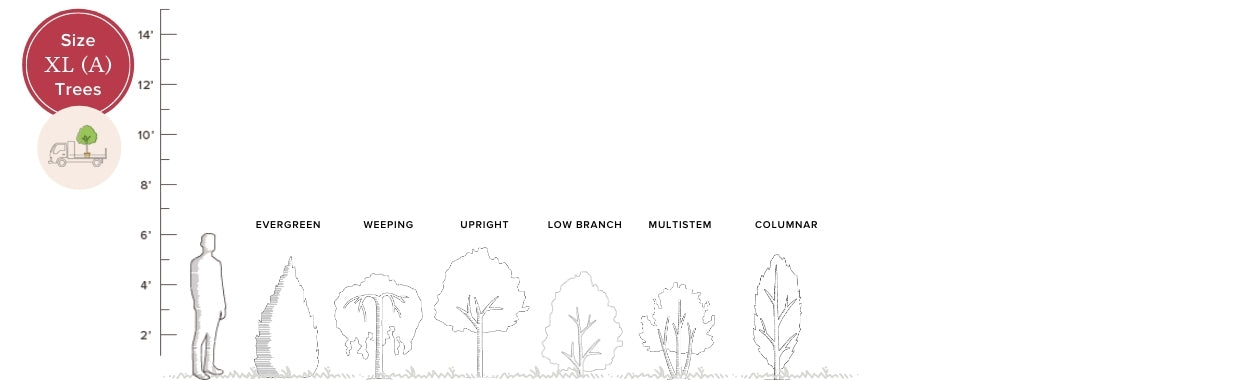
The size of our trees have nothing to do with the container size like you may find elsewhere–big doesn't mean just height - it’s also vigor, age, and overall health. Other online retailers are going to tell you that a plant is a seven gallon, that means nothing to your tree or plant (or you.)
Our trees for sale online are graded on large, x-large, and even bigger sizes. This is because our trees are sized by their age—the higher the letter, the more mature the tree. The age determines the trees’ overall height, size of the trunk and the overall branch density.
All of these characteristics are what you should be looking for when choosing a tree for immediate impact and instant curb appeal. Our extra-large tree and plant sizes are sure to wow you and your neighbors!
See the size guides below.