Why Plant Overcup Oak?
A strong, sturdy shade tree to last through the ages! Overcup Oak is a long-lived native forest tree that will please many generations of nature lovers, shade seekers, and bird watchers. In spring, deep green leaves emerge with a fuzzy white underside. By fall, they turn shades of yellow, but in some instances, they can be more orange to red hues! This wonderful bird-friendly tree hosts a vast array of caterpillars and other insects that songbirds adore. Chickadees, warblers, tanagers, gnatcatchers, titmice, vireos, and many other birds rely on these protein-packed morsels for their survival and that of their rapidly growing chicks. For larger birds like Blue Jays, Turkeys, and Woodpeckers, Overcup Oak’s acorns will supply additional nourishment in the fall.
Overcup Oak gets its name from its unique acorns, which are mostly covered by a larger-than-normal cap. This cap helps the seed float away on the water that is usually at the feet of this moisture-loving tree. In the wild, Overcup Oak grows in wet soil near the Atlantic Coast, from New Jersey to Texas, and along the Mississippi River Valley to Illinois. Another name for Overcup Oak is Swamp Post Oak, a reference to its affinity for swampy soil and for its use in making fence posts. The wood is dense and strong, and it resists rotting.
How to use Overcup Oak in the landscape?
Overcup Oak is a slow but steady grower. This slow growth is what makes the wood so strong and resistant to storm damage. Overcup Oak typically develops into a stocky tree with a dense, rounded crown. With great age, it can become very tall, however. The national champion, in Virginia, stands 124 feet tall! Its trunk is eight-and-a-half feet thick.
Planting Zones
Hardiness Zone: 5-9

How To Plant Overcup Oak
Plant your Overcup Oak in an area where it will have lots of elbow room and will receive full sun all day. It is not fussy about soil; clay soil is super. Although Overcup Oak is native to wet—even flooded—spaces, it does not need to be grown in a swamp. Well-drained soils of average moisture levels are fine.
How To Water
You will want to be sure to irrigate regularly during the first couple of years of establishment to ensure your tree has a healthy root system.
How To Fertilize
When planting the Overcup Oak, it is best to feed your new tree with the Bower & Branch Elements Starter Plant Food. From there, you can reapply each spring, this way, your tree has all it needs for a healthy growing season!
How To Prune
Little pruning will be necessary on this slow growing gentle giant, but if you must prune, do so only between December and February. The fungal disease Oak Wilt can strike when Oaks are pruned during active growth. A member of the White Oak Group, Overcup Oak is less susceptible to Oak Wilt than members of the Red Oak Group, but it is still vulnerable.
How Does Shipping Work?
Bower & Branch Trees, the real BIG trees, don’t fit in a box! Our big trees, sizes XL and bigger, require expert delivery and care, that means our extra-large trees are shipped on Bower & Branch trucks. We are the only ones who know how to ship our big and bigger trees and plants with tender loving care. We deliver your trees and plants directly to you. Ask Bower & Branch about planting services – we'd be happy to assist in installation.
*For Big trees and Shrubs, Size XL and bigger: Review our Seasonal Shipping Timelines and Policy here.
Your trees and plants are grown across the United States at various Bower & Branch Growers. Depending on your location, your plant orders may be shipped from various locations. Please expect orders with multiple items to be delivered over a number of days as a result. Orders made up of numerous items or selections will not arrive at your home on the same day.
Shipping Delays:
From time to time, Bower & Branch Growers may determine to delay order shipment based on various factors for plant health. Weather in your region, as well as, where your plants are grown, is always considered when shipping. Extreme weather conditions may delay some or all of your order. Bower & Branch allows our Growers to make final shipping decisions based solely to benefit your trees and plants’ health and success.
How Does Sizing Work?
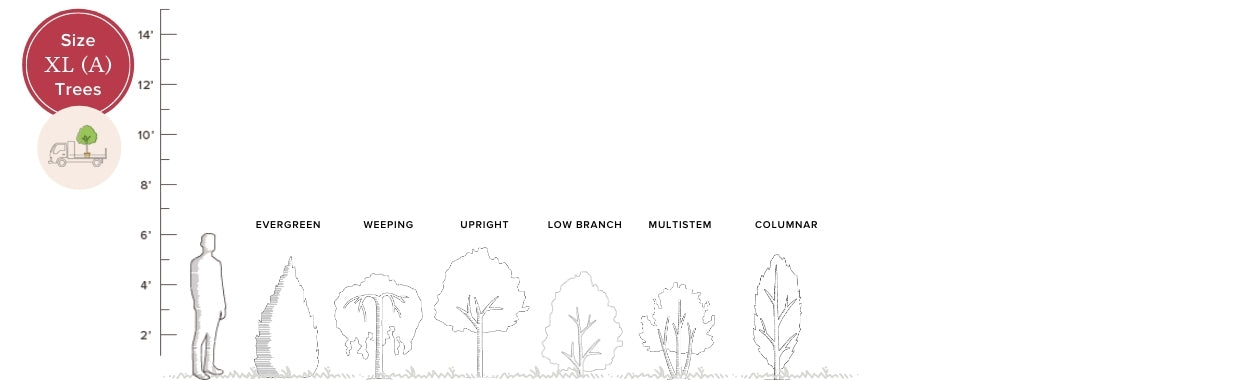
The size of our trees have nothing to do with the container size like you may find elsewhere–big doesn't mean just height - it’s also vigor, age, and overall health. Other online retailers are going to tell you that a plant is a seven gallon, that means nothing to your tree or plant (or you.)
Our trees for sale online are graded on large, x-large, and even bigger sizes. This is because our trees are sized by their age—the higher the letter, the more mature the tree. The age determines the trees’ overall height, size of the trunk and the overall branch density.
All of these characteristics are what you should be looking for when choosing a tree for immediate impact and instant curb appeal. Our extra-large tree and plant sizes are sure to wow you and your neighbors!
See the size guides below.