Why Plant Pecan?
Looking for a tree to provide bountiful harvests for generations to come? Then the Pecan is what you've been looking for! Thousands of years before the colonization of the Americas, the Indigenous people of the land utilized the abundant harvest this tree provides for sustenance. With the arrival of settlers came the worldwide demand for these flavorful nuts, with the first recorded shipment to England occurring in 1761. Pecan trees are large, native trees reaching heights of 70’ up to, and even in some cases, surpassing 100’. The Pecan tree is monoecious; one tree produces both male and female blooms and are capable of self-pollination. With that being said, you will achieve a larger harvest having at least one more planted close by!
The mighty Pecan is an American tree that has nourished both humans and wildlife here for thousands of years. It’s found primarily in the midsection of the country, where it follows the Mississippi and Ohio Rivers. In these moist, fertile lands, it flourishes, growing more quickly than other Hickory Trees (Pecan is a type of Hickory). Thomas Jefferson was a fan of Pecans. He planted several at Monticello, and he convinced his friend, George Washington, to plant some at Mt. Vernon as well. Uncommon on the East Coast, Pecans were known as “Illinois Nuts” to Jefferson.
How to use Pecan in the landscape?
When considering the Pecan Tree for your property, there are some aspects you must look into. The yield of the Pecan Tree changes year to year, offering more abundance one year to the next. Areas in full sunlight will do this tree wonders, but don't underestimate the adaptability of soil types allowing for a wide variety of planting locations. This is the type of tree to plant on generational properties for your family to enjoy and harvest for years to come as some trees have been known to live upwards of 300 years or more! The fruits or nuts of the Pecan Tree are favored by many wildlife creatures, as well as people, and have been utilized in cooking and baking for many years. These trees should be planted at least 30’ apart, and 20’ or more from buildings. Locations offering full sun, and well draining soil will offer you the best growth possible. The Pecan tree does require space to grow, so although this may seem like a tree fitting for a home with more yard space, try donating some to a local park and enjoy the harvest with the community!
Planting Zones
Hardiness Zone: 5-9

How To Plant Pecan
Being native to the Americas aids in this tree's adaptability to most soil types found locally. We find that full sun will do your Pecan best when considering the health and harvest of this tree. Remember to water accordingly and fertilize when necessary to ensure proper growth!
How To Water
Newly planted Pecan trees do not require as much water as you would think. You may achieve a healthy Pecan tree by watering once a week, making sure to penetrate at least 6'' but for best results upwards of 8” will do wonders!
How To Fertilize
After planting your Pecan Tree, you may apply fertilizer in early spring to promote the health and growth of your new Pecan tree. Here at Bower & Branch, we offer our all natural Elements Starter Plant Food, giving your tree everything it needs to thrive in its new forever home!
How To Prune
Pruning Pecan trees should occur come winter's end, before the start of new growth. This is normally required at least once every three years on mature trees. Keeping this pruning practice will reduce crowding of branches and allow sunlight and air to reach evenly throughout the tree. You may want to pay attention to any branches growing at tighter angles, for they will be weak and possibly break off!
How Does Shipping Work?
Bower & Branch Trees, the real BIG trees, don’t fit in a box! Our big trees, sizes XL and bigger, require expert delivery and care, that means our extra-large trees are shipped on Bower & Branch trucks. We are the only ones who know how to ship our big and bigger trees and plants with tender loving care. We deliver your trees and plants directly to you. Ask Bower & Branch about planting services – we'd be happy to assist in installation.
*For Big trees and Shrubs, Size XL and bigger: Review our Seasonal Shipping Timelines and Policy here.
Your trees and plants are grown across the United States at various Bower & Branch Growers. Depending on your location, your plant orders may be shipped from various locations. Please expect orders with multiple items to be delivered over a number of days as a result. Orders made up of numerous items or selections will not arrive at your home on the same day.
Shipping Delays:
From time to time, Bower & Branch Growers may determine to delay order shipment based on various factors for plant health. Weather in your region, as well as, where your plants are grown, is always considered when shipping. Extreme weather conditions may delay some or all of your order. Bower & Branch allows our Growers to make final shipping decisions based solely to benefit your trees and plants’ health and success.
How Does Sizing Work?
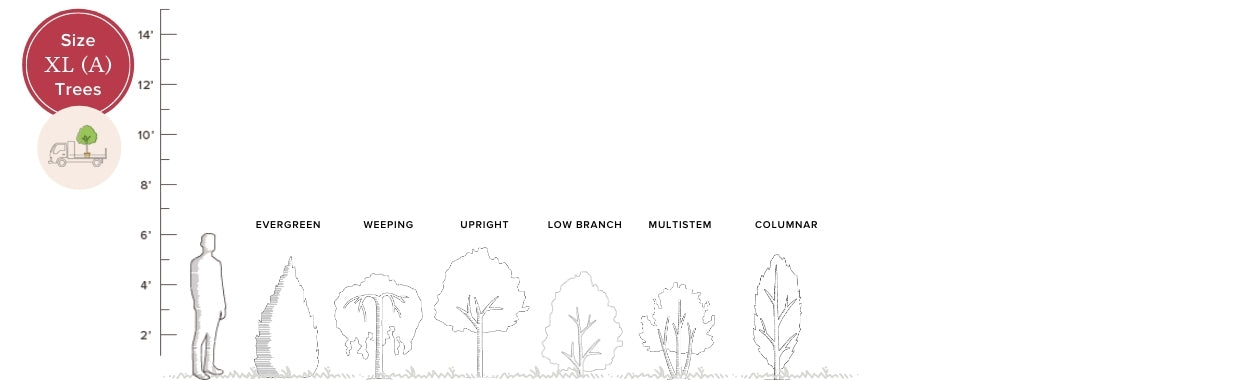
The size of our trees have nothing to do with the container size like you may find elsewhere–big doesn't mean just height - it’s also vigor, age, and overall health. Other online retailers are going to tell you that a plant is a seven gallon, that means nothing to your tree or plant (or you.)
Our trees for sale online are graded on large, x-large, and even bigger sizes. This is because our trees are sized by their age—the higher the letter, the more mature the tree. The age determines the trees’ overall height, size of the trunk and the overall branch density.
All of these characteristics are what you should be looking for when choosing a tree for immediate impact and instant curb appeal. Our extra-large tree and plant sizes are sure to wow you and your neighbors!
See the size guides below.