Why Plant Sugarberry?
You probably don’t know Sugarberry, but your neighborhood birds do! This Elm relative (it does not get Dutch Elm disease) flies under most people’s radar, but it does not go unnoticed by birds. In early fall, its sweet and nutritious, reddish-brown fruits are feasted upon by robins, mockingbirds, Cedar Waxwings, orioles, and cardinals. In rural areas, turkeys, Ruffed Grouse, quail, ducks, and pheasants will partake. (Were it not for the large, rock-hard seeds, people would like the date-flavored fruits, too!) To top it all off, Sugarberry’s twiggy branches make choice nesting sites for robins and other tree-dwellers.
Sugarberry is a sister to the Common Hackberry, another tough, native shade tree that nourishes wildlife. The two trees are similar in many respects, though Sugarberry usually has a smoother bark (at times Beech-like), and a more southernly distribution (it is native throughout the Southeast). Both are first-class butterfly trees in addition to being stellar bird trees. They attract Hackberry butterflies, Tawny Emperors, Mourning Cloaks, Question Marks, and American Snouts. Some of these lovelies will end up in the bellies of birds. Others will go on to live out their lives in your garden.
How to use Sugarberry in the landscape?
Sugarberry should be called the “Butterfly Tree” for the wealth of butterflies it supports. Perhaps the most charming is the Hackberry butterfly. This endearing little creature loves people (actually, it likes to sip the salts from our skin). You may feel a tickle while you’re working in the garden and find a Hackberry butterfly has landed on you!
Planting Zones
Hardiness Zone: 5-9

How To Plant Sugarberry
Sugarberry will grow fastest in full sun or light shade, in soil that is rich and moist. However, it will put up with poor growing conditions without complaint. Once established, Sugarberry tolerates clay soil, rocky soil, pollution, high winds, salt spray, extreme heat, and winter lows to -20ºF. One thing you’ll want to be careful about, however, is not wounding the bark with equipment. Sugarberry bark is thin and vulnerable to damage, especially in its youth.
How To Water
After planting, you are going to want to water your Sugarberry deeply. From there, water twice a week for the first growing season. The following season, once a week should be sufficient.
How To Fertilize
When planting your Sugarberry, you should fertilize with the Bower & Branch Elements Starter Plant Food. Repeat your fertilizer application each spring. This will ensure that your tree has all it needs as it grows throughout the season!
How To Prune
Prune your Sugarberry tree in late winter to early spring, before it breaks dormancy. Remove any cross branching that you may see or damaged branches.
How Does Shipping Work?
Bower & Branch Trees, the real BIG trees, don’t fit in a box! Our big trees, sizes XL and bigger, require expert delivery and care, that means our extra-large trees are shipped on Bower & Branch trucks. We are the only ones who know how to ship our big and bigger trees and plants with tender loving care. We deliver your trees and plants directly to you. Ask Bower & Branch about planting services – we'd be happy to assist in installation.
*For Big trees and Shrubs, Size XL and bigger: Review our Seasonal Shipping Timelines and Policy here.
Your trees and plants are grown across the United States at various Bower & Branch Growers. Depending on your location, your plant orders may be shipped from various locations. Please expect orders with multiple items to be delivered over a number of days as a result. Orders made up of numerous items or selections will not arrive at your home on the same day.
Shipping Delays:
From time to time, Bower & Branch Growers may determine to delay order shipment based on various factors for plant health. Weather in your region, as well as, where your plants are grown, is always considered when shipping. Extreme weather conditions may delay some or all of your order. Bower & Branch allows our Growers to make final shipping decisions based solely to benefit your trees and plants’ health and success.
How Does Sizing Work?
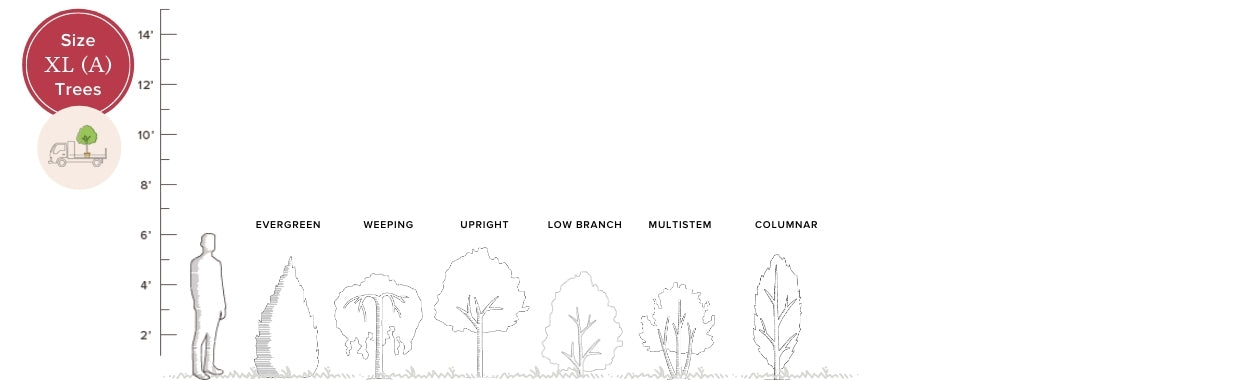
The size of our trees have nothing to do with the container size like you may find elsewhere–big doesn't mean just height - it’s also vigor, age, and overall health. Other online retailers are going to tell you that a plant is a seven gallon, that means nothing to your tree or plant (or you.)
Our trees for sale online are graded on large, x-large, and even bigger sizes. This is because our trees are sized by their age—the higher the letter, the more mature the tree. The age determines the trees’ overall height, size of the trunk and the overall branch density.
All of these characteristics are what you should be looking for when choosing a tree for immediate impact and instant curb appeal. Our extra-large tree and plant sizes are sure to wow you and your neighbors!
See the size guides below.