Why Plant Common Persimmon?
The Common Persimmon isn’t common at all, although it deserves to be planted more often in landscapes across the country. This noble shade tree is admired for its dark, ruggedly handsome bark, which has a blocky pattern resembling the deep tread of a snow tire. It also delivers a wonderful splash of fall color with foliage that turns glowing yellow and in some cases takes on reddish tones. And on female trees, orange fruits may form that serve up a delectable dollop of all-natural, sugary-sweet goodness—the likes of which you’ll never find in the produce aisle of the grocery store. The “Common” Persimmon is truly extraordinary!
Native from Connecticut to Florida and reaching as far west as Kansas, the Common Persimmon is a part of our country’s natural heritage. Since the days of the earliest Native Americans, its fruits have been a special treat for people in the East and Midwest. Don’t eat them before they’re ripe, though! Biting into a bitter persimmon before it’s ready is a mistake you’ll only make once. When they’re jelly-soft, however, they become as sweet as candy. Because the wood of the Persimmon Tree is incredibly hard, it’s used to make golf club heads. This tree is closely related to Ebony, a tropical tree with extremely dark, dense wood that has traditionally been used to make the black keys on pianos.
How to use Common Persimmon in the landscape?
One little-known feature of the uncommon Common Persimmon Tree is that it is a favored host plant for the stunning luna moth. This large jade green beauty is a sight you’ll never forget if you’re lucky enough to glimpse one gliding by on a warm summer evening.
Planting Zones
Hardiness Zone: 4-9

How To Plant Common Persimmon
Common Persimmon flourishes in fencerows and other wild spaces all over the eastern U.S., and it will most likely thrive in your garden as well without a lot of fuss. Give it a site in all-day sun in soil that drains well. Try to avoid damaging the trunk, which will encourage this tree’s natural tendency to sucker.
How To Water
Regular water is important during the establishment period, but once its sturdy roots are firmly anchored in the ground, your Persimmon will be quite drought tolerant.
How To Fertilize
Incorporate Elements Starter Plant Food granular form into the soil when planting. If planting in spring or summer, start fertilizing late fall using Elements Starter Plant Food granular form on an annual basis each late fall. If planting in the fall, use Elements fertilizer while planting and start your regular annual fertilizing the following fall. Continue this for the first three years to get your plant well established as it gives your tree the nutrients it needs to produce lush new growth for the following spring.
How To Prune
Suckers may be cut or mowed off to maintain a single-trunked specimen, or they may be left to do their thing if you’d like a multi-stemmed, seasonal privacy screen to develop. Pruning on your Persimmon is best done during late winter to early spring, when the tree is dormant.
How Does Shipping Work?
Bower & Branch Trees, the real BIG trees, don’t fit in a box! Our big trees, sizes XL and bigger, require expert delivery and care, that means our extra-large trees are shipped on Bower & Branch trucks. We are the only ones who know how to ship our big and bigger trees and plants with tender loving care. We deliver your trees and plants directly to you. Ask Bower & Branch about planting services – we'd be happy to assist in installation.
*For Big trees and Shrubs, Size XL and bigger: Review our Seasonal Shipping Timelines and Policy here.
Your trees and plants are grown across the United States at various Bower & Branch Growers. Depending on your location, your plant orders may be shipped from various locations. Please expect orders with multiple items to be delivered over a number of days as a result. Orders made up of numerous items or selections will not arrive at your home on the same day.
Shipping Delays:
From time to time, Bower & Branch Growers may determine to delay order shipment based on various factors for plant health. Weather in your region, as well as, where your plants are grown, is always considered when shipping. Extreme weather conditions may delay some or all of your order. Bower & Branch allows our Growers to make final shipping decisions based solely to benefit your trees and plants’ health and success.
How Does Sizing Work?
The size of our trees have nothing to do with the container size like you may find elsewhere–big doesn't mean just height - it’s also vigor, age, and overall health. Other online retailers are going to tell you that a plant is a seven gallon, that means nothing to your tree or plant (or you.)
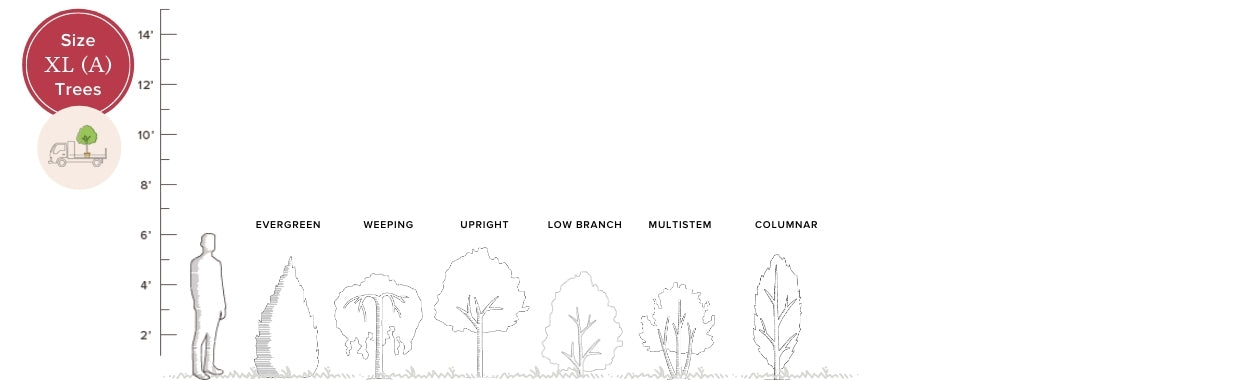
Our trees for sale online are graded on large, x-large, and even bigger sizes. This is because our trees are sized by their age—the higher the letter, the more mature the tree. The age determines the trees’ overall height, size of the trunk and the overall branch density.
All of these characteristics are what you should be looking for when choosing a tree for immediate impact and instant curb appeal. Our extra-large tree and plant sizes are sure to wow you and your neighbors!
See the size guides below.