Why Plant Summercrisp European Pear?
If you love pears but wish they had a little more crunch and a lot less “mushy surprise,” this one is a joy. It was developed for colder climates and ripens early, with fruit that’s at its best when it’s still firm and crisp, more “fresh bite” than “soft dessert.” The pears hang in late summer in generous clusters, chartreuse-green with a sunny red blush that makes the harvest feel extra rewarding. And when spring rolls in, it doesn’t just quietly do fruit-tree things, it puts on a show of white blossoms with purple anthers that feel like a promise of what’s coming.
How to use Summercrisp European Pear in the landscape?
If you love pears but wish they had a little more crunch and a lot less “mushy surprise,” this one is a joy. It was developed for colder climates and ripens early, with fruit that’s at its best when it’s still firm and crisp, more “fresh bite” than “soft dessert.” The pears hang in late summer in generous clusters, chartreuse-green with a sunny red blush that makes the harvest feel extra rewarding. And when spring rolls in, it doesn’t just quietly do fruit-tree things, it puts on a show of white blossoms with purple anthers that feel like a promise of what’s coming.
How Does Shipping Work?
Bower & Branch Trees, the real BIG trees, don’t fit in a box! Our big trees, sizes XL and bigger, require expert delivery and care, that means our extra-large trees are shipped on Bower & Branch trucks. We are the only ones who know how to ship our big and bigger trees and plants with tender loving care. We deliver your trees and plants directly to you. Ask Bower & Branch about planting services – we'd be happy to assist in installation.
*For Big trees and Shrubs, Size XL and bigger: Review our Seasonal Shipping Timelines and Policy here.
Your trees and plants are grown across the United States at various Bower & Branch Growers. Depending on your location, your plant orders may be shipped from various locations. Please expect orders with multiple items to be delivered over a number of days as a result. Orders made up of numerous items or selections will not arrive at your home on the same day.
Shipping Delays:
From time to time, Bower & Branch Growers may determine to delay order shipment based on various factors for plant health. Weather in your region, as well as, where your plants are grown, is always considered when shipping. Extreme weather conditions may delay some or all of your order. Bower & Branch allows our Growers to make final shipping decisions based solely to benefit your trees and plants’ health and success.
How Does Sizing Work?
The size of our trees have nothing to do with the container size like you may find elsewhere–big doesn't mean just height - it’s also vigor, age, and overall health. Other online retailers are going to tell you that a plant is a seven gallon, that means nothing to your tree or plant (or you.)
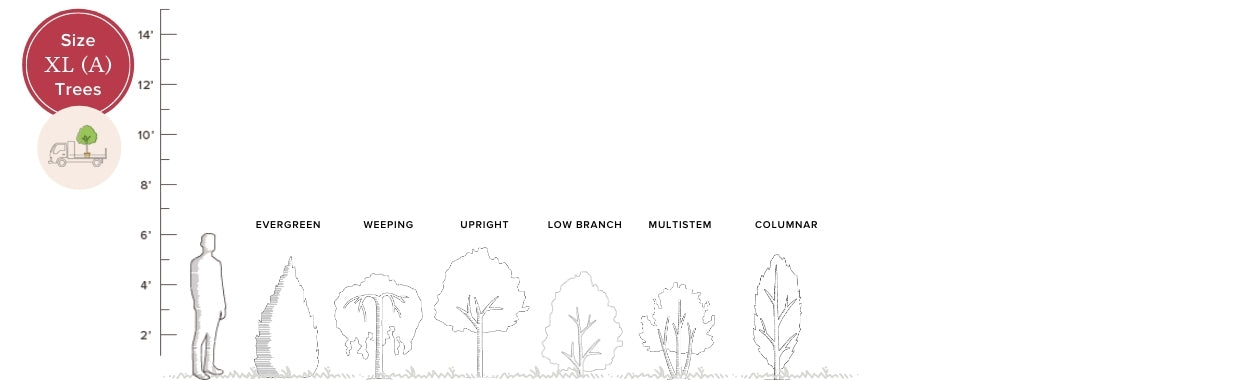
Our trees for sale online are graded on large, x-large, and even bigger sizes. This is because our trees are sized by their age—the higher the letter, the more mature the tree. The age determines the trees’ overall height, size of the trunk and the overall branch density.
All of these characteristics are what you should be looking for when choosing a tree for immediate impact and instant curb appeal. Our extra-large tree and plant sizes are sure to wow you and your neighbors!
See the size guides below.