Why Plant Cortland Apple?
The Cortland Apple is an heirloom apple that has been a favorite of many since the time your grandparents or even great-grandparents were kids. With a Cortland Apple Tree in your yard, you’ll be able to enjoy the taste of this sweet, juicy classic just like they did. In fact, the flavor is most intense right off the tree and declines somewhat in storage, so the way to truly appreciate this variety is to avoid store-bought apples and grow your own tree. Cortland apples that have been in storage for awhile are still great for cooking and will make mouth-watering pies, strudels, cakes, jellies, and applesauce.
The Cortland Apple debuted in 1915 from the New York State Agricultural Experiment Station in Geneva and was named for Cortland County, New York. Its parents were the famous McIntosh Apple, which contributed a lot of the flavor, and a variety called ‘Ben Davis’, which gave this tree its excellent cold-hardiness. Another remarkable trait of the Cortland apple is that the snow-white flesh is extremely resistant to browning, so slices you cut for a salad or fruit tray won’t get yucky. This tree opens its lovely white blossoms in mid-season and will set fruit without a pollinator, although having another Apple Tree or Crabapple Tree in the vicinity will improve production.
Our grower, Boyer’s Nursery, grows a strain of Cortland apple named Cardinal Cortland Apple, which they developed at their nursery. They tell orchard growers that they can represent it simply as Cortland and the buyer will be very pleased. The strain differences are very grower oriented but valuable enough so that Boyers has completely switched over to the Cardinal strain of Cortland. They no longer grow regular Cortland at all. Emma Lower Fleming, a member of the 5th generation running the farm since the land was purchased in 1900, tells us her great-grandmother was the one responsible for recognizing the value in the strain and naming it. In comparing the two, the Cardinal strain has a little more of a green base color and the fruit size is larger. It has all the other attributes of regular Cortland. The Cardinal addition to the name says it is a strain of Cortland.
A strain is a known cultivar that differs in some way from the natural vegetative characteristics of the original cultivar. The difference may be in fruit color development, fruit maturity or growth habit. For example ‘Daybreak Fuji’ is an early maturing strain of ‘Fuji’. ‘Super Chief Delicious’ is a strain of ‘Red Chief Delicious’. For some cultivars, there are hundreds of strains that have been found over the years, some of which are no longer commercially available as better strains are found.
How do strains develop? A bud may naturally mutate during cell division on an established tree. If that bud grows out to become a branch producing fruit that is of different appearance; it may be noticed by the fruit grower. The branch is marked and maintained. The limb with the fruit is observed for 2-3 growing seasons to be certain it is permanent.
The difference between an apple cultivar and an apple strain is in the origin; a cultivar is a seedling apple from an intentional or unintentional cross between two apples while the origin of a strain is as a branch sport.
How to use Cortland Apple in the landscape?
With a Cortland Apple Tree in the backyard, wholesome snacking is right outside your door. You can feel good about the kids indulging in these sweet treats to their heart's content. Low-calorie apples—a good source of fiber, vitamin C, and antioxidants—have been shown to combat asthma and some forms of cancer and to help your body regulate blood sugar levels.
Planting Zones
Hardiness Zone: 4-7

How To Plant Cortland Apple
In general, Apple Trees are easy to grow, but getting a big harvest of unblemished fruit can be a real challenge, as there are several pests and diseases that find Apples like Cortland as tasty as we do. There are many steps you can take, however, to protect your tree in effective but responsible ways. Our growers are happy to help you find the best plan for you; contact them anytime at grower@bowerandbranch.com. Practicing good culture and hygiene will go a long way towards keeping your tree strong and healthy. Plant your Cortland Apple Tree in full sun in a site with well-drained soil and good air circulation.
How To Water
Water deeply, and regularly during its first few years in the ground. Irrigate weekly, and especially during long dry spells or extreme heat after it’s established.
How To Fertilize
Incorporate Elements Starter Plant food granular form into the soil when planting. If planting in spring or summer, start fertilizing late fall using Elements Starter Plant food granular form on an annual basis each late fall. Continue this for the first three years to get your plant well established.
How To Prune
Always promptly remove and destroy any diseased branches, leaves, or fruit from your Apple tree and around the base. Leaving those in place could cause reinfection the following year.
How Does Shipping Work?
Bower & Branch Trees, the real BIG trees, don’t fit in a box! Our big trees, sizes XL and bigger, require expert delivery and care, that means our extra-large trees are shipped on Bower & Branch trucks. We are the only ones who know how to ship our big and bigger trees and plants with tender loving care. We deliver your trees and plants directly to you. Ask Bower & Branch about planting services – we'd be happy to assist in installation.
*For Big trees and Shrubs, Size XL and bigger: Review our Seasonal Shipping Timelines and Policy here.
Your trees and plants are grown across the United States at various Bower & Branch Growers. Depending on your location, your plant orders may be shipped from various locations. Please expect orders with multiple items to be delivered over a number of days as a result. Orders made up of numerous items or selections will not arrive at your home on the same day.
Shipping Delays:
From time to time, Bower & Branch Growers may determine to delay order shipment based on various factors for plant health. Weather in your region, as well as, where your plants are grown, is always considered when shipping. Extreme weather conditions may delay some or all of your order. Bower & Branch allows our Growers to make final shipping decisions based solely to benefit your trees and plants’ health and success.
How Does Sizing Work?
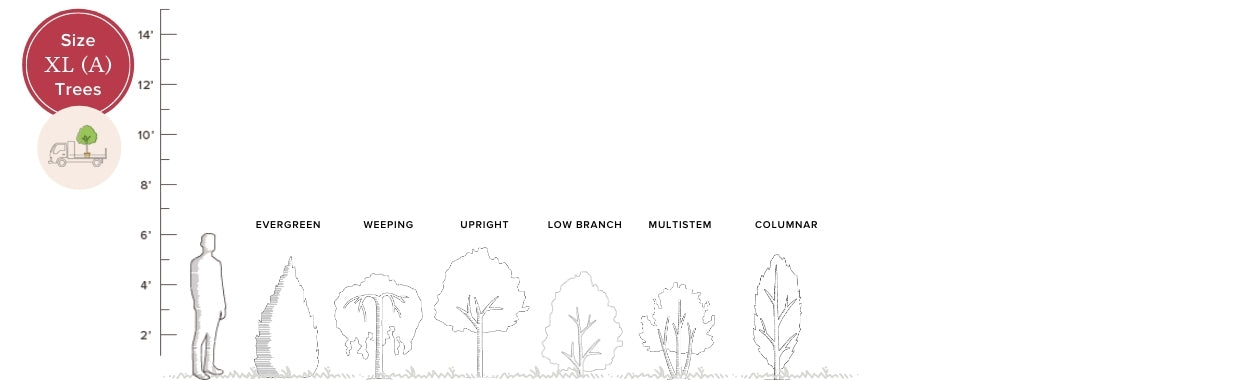
The size of our trees have nothing to do with the container size like you may find elsewhere–big doesn't mean just height - it’s also vigor, age, and overall health. Other online retailers are going to tell you that a plant is a seven gallon, that means nothing to your tree or plant (or you.)
Our trees for sale online are graded on large, x-large, and even bigger sizes. This is because our trees are sized by their age—the higher the letter, the more mature the tree. The age determines the trees’ overall height, size of the trunk and the overall branch density.
All of these characteristics are what you should be looking for when choosing a tree for immediate impact and instant curb appeal. Our extra-large tree and plant sizes are sure to wow you and your neighbors!
See the size guides below.