Why Plant Pagoda Dogwood?
Pagoda Dogwood is so named for its horizontal branching structure that brings to mind the layered tiers of a Chinese pagoda. This small but wide-spreading ornamental tree will grace your landscape with an easy elegance that compliments both formal and informal style. Its architectural lines are most striking in winter, when the horizontal branches are laid bare and topped with snow, or in late spring, when they're peppered with fuzzy white flowers, but we like Pagoda Dogwood best in summer, when songbirds come to plunder the fruits. Start your day with a cup of joe on the deck, watching the birds enjoying your Pagoda Dogwood, and we guarantee you can't help but face the day in a good mood!
Pagoda Dogwood's species name, "alternifolia", refers to the fact that it's the only dogwood with leaves arranged alternately, or in zigzag fashion along the branches. If you examine any other dogwood -- Flowering Dogwood, Japanese "Kousa" Dogwood, even the shrubby Red-Twigs -- you'll see that the leaves are arranged in pairs. Though a native tree, Pagoda Dogwood hasn't played much of a role in American history. The wood is too spindly to build with and the fruits are too icky for human consumption. Birds, squirrels, and bears have enjoyed having this one all to themselves.
How to use Pagoda Dogwood in the landscape?
Quite a lot of stuff going on with this one! Clusters of fragrant, small, white flowers appear in spring. Medium to dark green foliage endures throughout spring and summer changing to yellow with a mix of red and purple. Green fruit changes to red then to blue-black, only to be gobbled up by our feathered friends. Native to the eastern U.S., this tree is best used in naturalistic settings, edges of woods, or as a specimen.
Planting Zones
Hardiness Zones: 3-7

How To Plant Pagoda Dogwood
Pagoda Dogwood grows wild from Minnesota to Alabama, though it does better in the northern part of its range. It likes cool summers, consistent moisture, and some shade. Its natural habitat is along the margins of swamps (but not in them) or in the forest understory. A canker can be troublesome with this species. The best defense is to keep the tree healthy and vigorous -- mulch, regular water, and good drainage are key. Be sure to plant it where you can watch the birds feast on the fruits!
How To Water
Water twice weekly for the first 3-5 weeks; then water weekly for the remainder of the year until winter. When you water, water slowly and thoroughly. Watering needs may be altered due to extreme weather conditions.
How To Fertilize
Incorporate Elements Starter Plant Food granular form into the soil when planting. If planting in spring or summer, start fertilizing late fall using Elements Starter Plant Food granular form on an annual basis each late fall. If planting in the fall, use Elements fertilizer while planting and start your regular annual fertilizing the following fall. Continue this for the first three years to get your plant well established as it gives your tree the nutrients it needs to produce lush new growth for the following spring.
How To Prune
As your tree grows, remove a few of the lower branches each year in mid to late summer. Remove these lower branches before they reach 1/2 inch in diameter. It is better to make small cuts to avoid cutting a large, more mature branch - this is too stressful for the tree. Each year, make any corrective pruning needed, paying particular attention to removing damaged branches, rubbing branches, multiple leaders at the top, or suckers at the base. Limit any pruning to no more than 25% of the branching structure in a given year. Pruning benefits the tree and helps to achieve a balanced tree form.
How Does Shipping Work?
Bower & Branch Trees, the real BIG trees, don’t fit in a box! Our big trees, sizes XL and bigger, require expert delivery and care, that means our extra-large trees are shipped on Bower & Branch trucks. We are the only ones who know how to ship our big and bigger trees and plants with tender loving care. We deliver your trees and plants directly to you. Ask Bower & Branch about planting services – we'd be happy to assist in installation.
*For Big trees and Shrubs, Size XL and bigger: Review our Seasonal Shipping Timelines and Policy here.
Your trees and plants are grown across the United States at various Bower & Branch Growers. Depending on your location, your plant orders may be shipped from various locations. Please expect orders with multiple items to be delivered over a number of days as a result. Orders made up of numerous items or selections will not arrive at your home on the same day.
Shipping Delays:
From time to time, Bower & Branch Growers may determine to delay order shipment based on various factors for plant health. Weather in your region, as well as, where your plants are grown, is always considered when shipping. Extreme weather conditions may delay some or all of your order. Bower & Branch allows our Growers to make final shipping decisions based solely to benefit your trees and plants’ health and success.
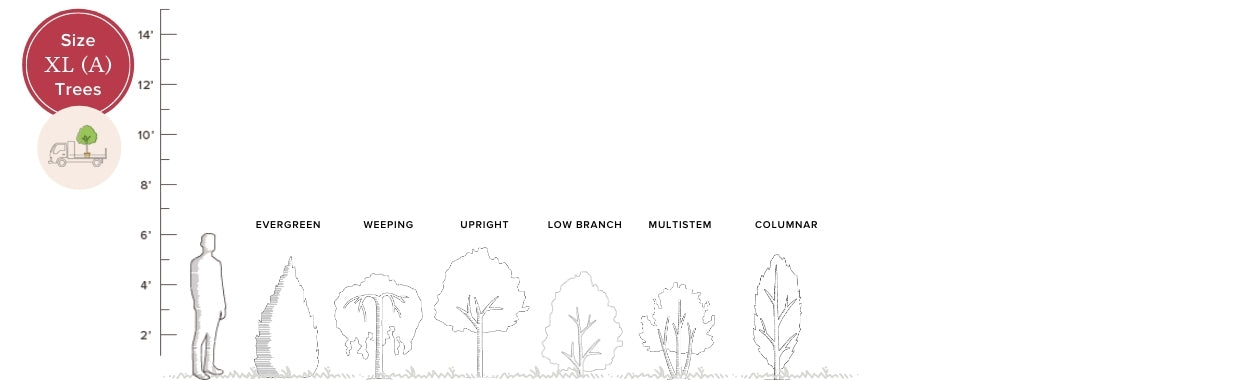
How Does Sizing Work?
The size of our trees have nothing to do with the container size like you may find elsewhere–big doesn't mean just height - it’s also vigor, age, and overall health. Other online retailers are going to tell you that a plant is a seven gallon, that means nothing to your tree or plant (or you.)
Our trees for sale online are graded on large, x-large, and even bigger sizes. This is because our trees are sized by their age—the higher the letter, the more mature the tree. The age determines the trees’ overall height, size of the trunk and the overall branch density.
All of these characteristics are what you should be looking for when choosing a tree for immediate impact and instant curb appeal. Our extra-large tree and plant sizes are sure to wow you and your neighbors!
See the size guides below.